
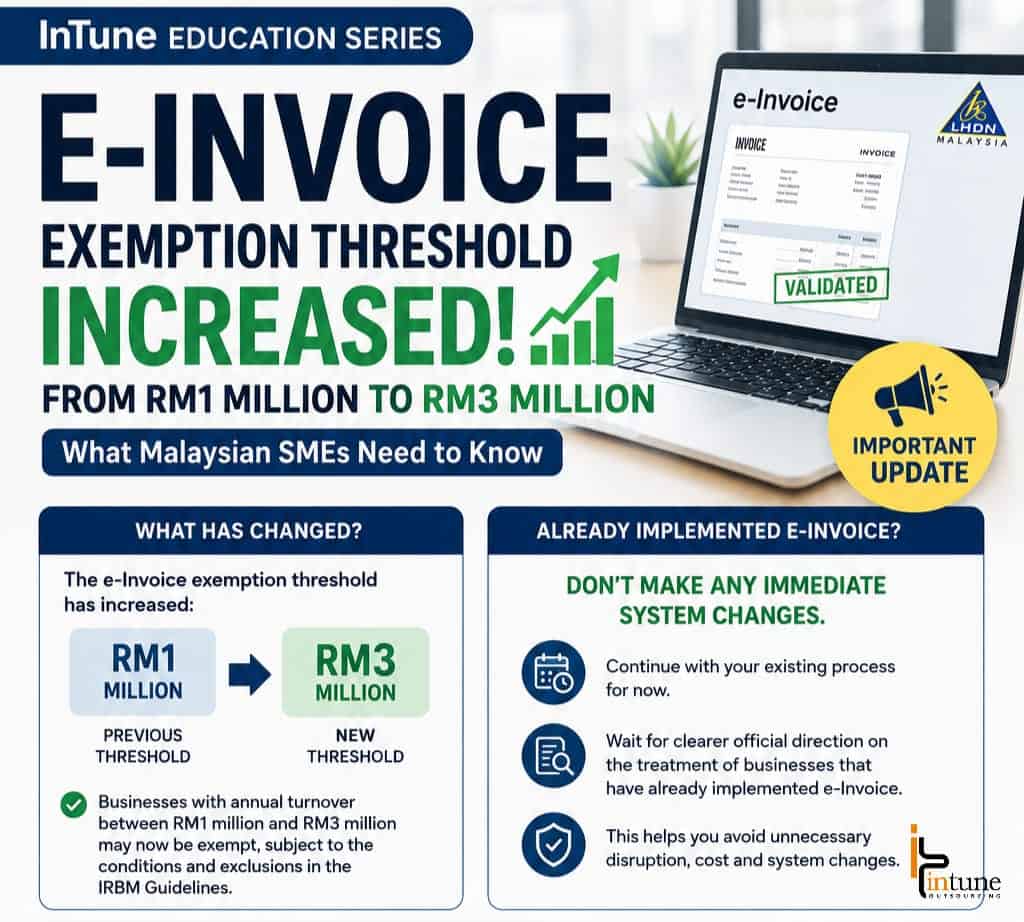
E-Invoice Exemption Threshold Increased from RM1 Million to RM3 Million — What Malaysian SMEs Need to Know
IMPORTANT UPDATE FOR MALAYSIAN BUSINESS OWNERS
Sept 2026
The Government has announced an increase in the e-Invoice exemption threshold from RM1 million to RM3 million in annual turnover or revenue.
The latest IRBM e-Invoice Guideline Version 4.8, dated 30 August 2026, reflects this important change.
For many Malaysian SMEs, this is welcome news.
But there is an important question that has not yet been fully clarified:
“What happens to businesses with annual turnover between RM1 million and RM3 million that have already implemented e-Invoice?”
DON’T MAKE ANY IMMEDIATE SYSTEM CHANGES.
Continue with your existing process until there is clearer official guidance on the treatment of businesses that have already implemented e-Invoice.
What Has Changed?
The e-Invoice exemption threshold has increased:
Previous threshold: RM1 million annual turnover/revenue
New threshold: RM3 million annual turnover/revenue
This means businesses falling within the RM1 million to RM3 million range may now benefit from the increased exemption, subject to the conditions and exclusions under the IRBM Guidelines.
It is therefore important not to simply look at your turnover figure and conclude: “My turnover is below RM3 million, so I don’t need e-Invoice.”
Your business structure and other circumstances may also need to be considered.
The Important Question: What If You Already Implemented e-Invoice?
Many SMEs with turnover between RM1 million and RM3 million may have already:
- Purchased or upgraded accounting software
- Configured their e-Invoice system
- Integrated their invoicing process with IRBM
- Trained their accounts and administration staff
- Changed their sales and invoicing procedures
- Started issuing e-Invoices to customers
Now that the exemption threshold has increased, some business owners may be asking:
“Can I stop e-Invoice immediately?”
At this point, we recommend not making an immediate change based solely on the announcement.
The practical treatment of businesses that have already implemented e-Invoice should be considered carefully together with the latest official guidance and any further clarification issued by IRBM/HASiL.
Why We Recommend Maintaining Your Current Process?
Imagine this:
ABC Sdn Bhd — Annual revenue: RM2.0 million
ABC has already implemented e-Invoice.
After hearing about the new RM3 million threshold, the owner immediately tells the accounts team: “We are below RM3 million. Turn off e-Invoice.”
The company changes its accounting system and invoicing procedures.
If subsequent clarification requires ABC to continue with its existing e-Invoice arrangement, the company may have to:
- Reconfigure the accounting system
- Change the invoicing process again
- Retrain employees
- Correct administrative issues
- Spend additional time and money
Why create unnecessary disruption?
Until the position is clearer, maintaining the current process provides continuity.
Don’t Look at Turnover Alone
Before deciding whether your business is affected by the new threshold, consider:
1. Annual turnover or revenue
Determine the relevant annual turnover/revenue of your business.
2. Business structure
Consider whether your company has related companies, holding companies, non-individual shareholders, joint ventures or other relevant corporate relationships.
3. Existing e-Invoice status
Ask: Have we already started implementing e-Invoice? If yes, don’t simply switch it off without considering the applicable guidance.
4. Your accounting system
If you have already invested in an integrated accounting and e-Invoice system, consider whether changing the system now is actually beneficial.
What Should SMEs Do Now?
Our recommendation is straightforward.
For businesses that have NOT implemented e-Invoice
Don’t immediately assume that you are exempt. First, review your turnover, business structure, exemption conditions and latest IRBM guidance before deciding what action is required.
For businesses that HAVE already implemented e-Invoice
For now:
Continue your existing process.
Avoid making immediate changes to your accounting system or invoicing procedures until there is clearer official direction on the treatment of businesses that have already implemented e-Invoice.
Remember: Exemption Doesn’t Mean “No Accounting Requirements”
Even if your business qualifies for an e-Invoice exemption, this does not mean that you can stop maintaining proper accounting records.
- Sales records
- Purchase records
- Expenses
- Supporting documents
- Bank records
- Payroll records
- Tax documentation
Good accounting records remain fundamental to proper business management and tax compliance.
Our Professional View
At InTune, we believe businesses should avoid making compliance decisions based purely on headlines or social media posts.
The announcement is positive news for many SMEs.
However, the correct question is not simply “Is my turnover below RM3 million?”
“Based on my turnover, business structure and circumstances, what does the latest IRBM guidance require me to do?”
And for businesses that have already implemented e-Invoice:
“What is the correct treatment now that the exemption threshold has increased?”
Until there is clearer direction, maintaining your current process is the more prudent approach.
How InTune Can Support You
Changes in tax and accounting requirements can be confusing, especially when businesses are trying to focus on running and growing their operations.
1. Accounting & Bookkeeping
Keeping your financial records organised, accurate and up to date so you have reliable information to run your business.
2. E-Invoice Implementation & Support
Helping you understand the applicable requirements, review your current process and support your e-Invoice setup where required.
3. Accounting Software
Helping you select and use suitable online accounting software and ensuring your accounting processes work efficiently with your business operations.
4. Payroll & HR Support
Supporting payroll processing, statutory contributions and HR administration so you can focus on your people and business.
5. Tax & Compliance Support
Working with your business to keep your accounting and compliance processes properly organised and aligned with applicable requirements.
6. Management Reporting
Turning your accounting data into meaningful reports so you can understand where your money is going, how profitable you really are, what you owe, what customers owe you, and where your business is heading.
7. Outsource Your Finance Function
You focus on sales, customers and growing your business. We help you manage the finance, accounting, payroll and administrative processes behind it.
IN SUMMARY
RM1 MILLION to RM3 MILLION
The increase in the e-Invoice exemption threshold is an important development for Malaysian SMEs.
But don’t rush to change your system.
– Already implemented e-Invoice?
Continue your existing process for the time being.
– Turnover between RM1m and RM3m but haven’t implemented?
Review your eligibility and the latest IRBM requirements before taking action.
– Don’t assume RM3 million automatically means exemption.
Check the conditions and exclusions.
– Keep your accounting records properly maintained regardless.
We will continue monitoring the latest announcements and guidelines from IRBM/HASiL and will update our clients when further clarification is available.
This article is prepared for general educational purposes only and should not be treated as specific tax or legal advice. Businesses should refer to the latest IRBM/HASiL guidelines and assess their individual circumstances before making compliance decisions.
Official reference: IRBM e-Invoice Guidelines, Version 4.8 — 30 August 2026.