
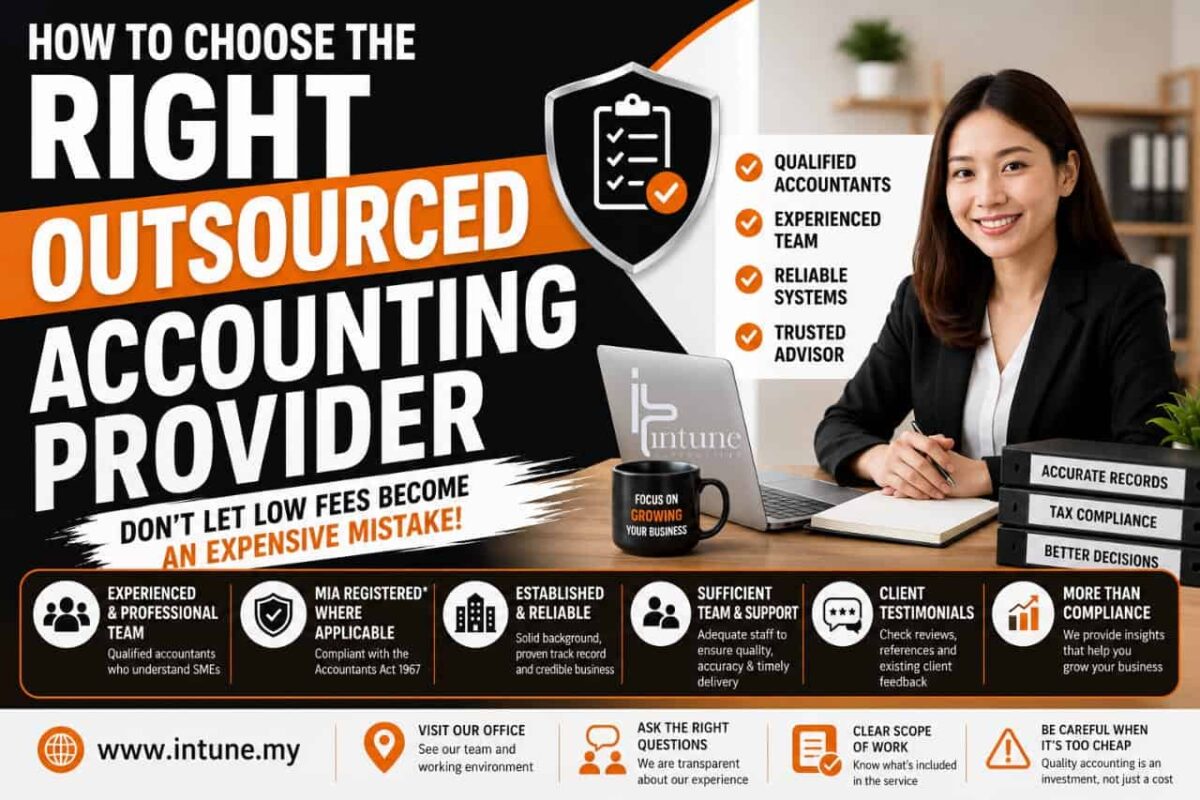
How to Choose the Right Outsourced Accounting Provider in Malaysia
For many Malaysian SMEs, outsourcing accounting is one of the smartest business decisions. It saves time, reduces overhead costs and gives business owners access to experienced finance professionals without the expense of maintaining a full in-house finance department.
However, choosing the wrong accounting provider can lead to costly mistakes, tax penalties, poor financial decisions and compliance issues.
While price is important, it should never be the only factor. If an accounting fee sounds too good to be true, it is worth asking why.
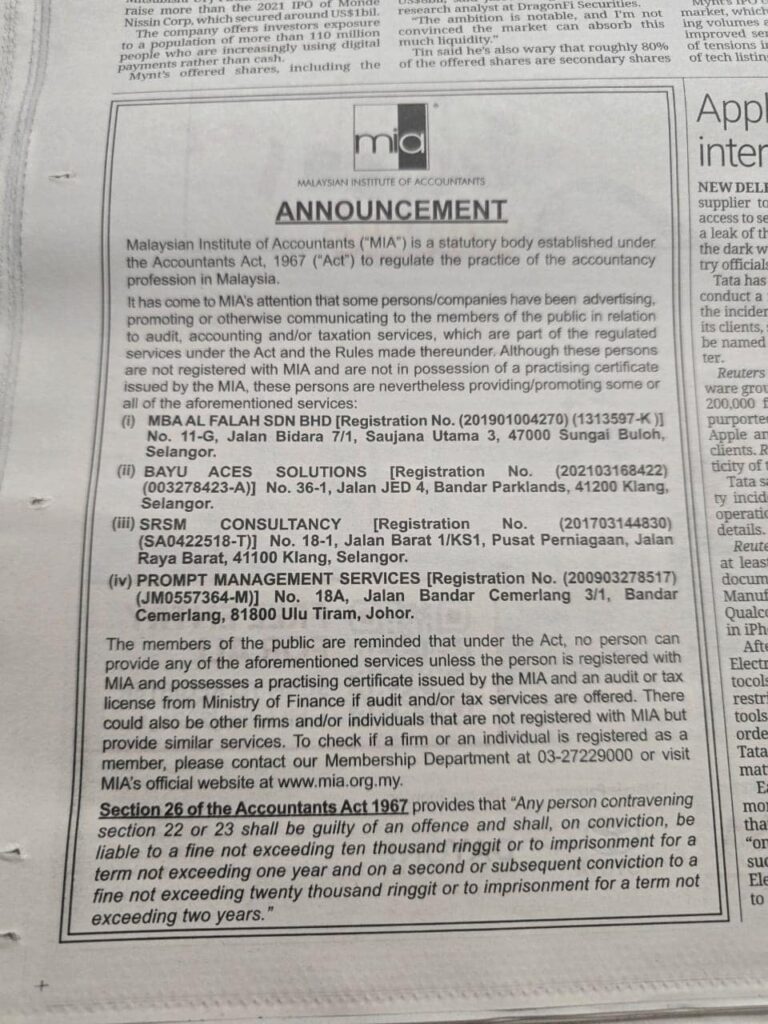
Recently, the Malaysian Institute of Accountants (MIA) issued a public announcement reminding the public that some companies and individuals have been advertising accounting, audit and taxation services without being properly registered or licensed under the Accountants Act 1967. This is a timely reminder for every business owner to perform proper due diligence before appointing an outsourced accounting provider.
1. Verify Their Qualifications and Professional Registration
Before appointing an accounting provider, ask:
- Are your accountants professionally qualified?
- Are they registered with the Malaysian Institute of Accountants (MIA), where required?
- Do you hold the necessary practising certificate if you provide regulated public practice services?
What does the law say?
The Accountants Act 1967 regulates the accounting profession in Malaysia.
In simple terms:
- The Act regulates who may practise as a professional accountant.
- Certain regulated accounting services require the appropriate registration and practising certificate.
- Section 26 provides penalties for breaches, including fines and imprisonment.
Understanding this helps business owners distinguish between professional accounting services and basic bookkeeping or administrative support.
2. Understand the Difference Between an Accountant and a Bookkeeper
Many people assume anyone preparing accounts is an “Accountant.”
This is not necessarily true.
Basic bookkeeping, payroll processing and data entry can be provided by trained personnel. However, the use of the title “Accountant” and the provision of certain regulated public practice services are governed by the Accountants Act 1967.
Ask your provider:
- Are you an MIA member?
- What professional qualifications do you hold?
- Who reviews my accounts?
- Are you licensed for the services you provide?
Professional firms will be transparent about their qualifications and registrations.
3. Look Beyond the Price
Many SMEs compare accounting firms based only on monthly fees.
This can be a costly mistake.
A provider charging RM1500 per month may not be delivering the same level of service as one charging RM2500.
Low fees may indicate:
- Limited review of your accounts
- Junior or inexperienced staff
- Poor supervision
- Minimal advisory support
- High client-to-staff ratios
- Limited compliance checks
- Software
- Confidentiality & Security
- Data and Information backup
What appears to be saving money may lead to thousands later in penalties or incorrect financial reporting.
4. Check Their Experience
Experience matters.
Ask questions such as:
- How long has the company been operating?
- How many SME clients do they serve?
- Do they specialise in businesses like mine?
- Do they understand my industry?
An experienced provider can often identify issues before they become expensive problems.
5. Meet the Team
Accounting is not just about software.
It is about people.
Ask:
- Who will actually handle my accounts?
- How many qualified staff does the firm employ?
- Is there a senior accountant reviewing my work?
- Will I have a dedicated contact person?
A firm with experienced accountants and an established support team is generally better equipped to provide consistent service.
6. Visit Their Office
Whenever possible, visit their office before signing an agreement.
Observe:
- Is the office professionally managed?
- Does the team appear organised?
- Are there sufficient staff?
- Are proper systems and procedures in place?
A physical visit provides confidence that you are dealing with an established business rather than a virtual operation with limited resources.
7. Ask for Client Testimonials and References
A reputable accounting firm should be able to provide:
- Client testimonials
- Google reviews
- Case studies
- Business references
Don’t be afraid to ask existing clients about their experience.
Long-term client relationships are often a good indication of service quality.
8. Use a Provider That Embraces Technology
Modern accounting should leverage reliable cloud accounting software.
Benefits include:
- Real-time financial information
- Faster reporting
- Secure cloud access
- Better collaboration
- Improved accuracy
Technology allows business owners to make faster and better-informed decisions.
9. Look for Business Advice, Not Just Compliance
A good outsourced accounting provider should do more than prepare your accounts.
They should help you:
- Improve cash flow
- Understand profitability
- Plan for tax obligations
- Monitor business performance
- Identify financial risks
- Support future growth
A great accountant becomes a trusted business adviser.
10. Be Careful When the Fees Are Too Cheap
Every business wants to reduce costs. You already reduce cost as compared to in house, so going to way below may result in compromising your business.
However, accounting is not an area where you should choose based solely on the lowest price.
Very low fees may mean:
- Inexperienced personnel
- Poor quality control
- Lack of professional oversight
- Delayed reporting
- Compliance risks
- Hidden charges later
Ask yourself:
“How can they provide quality professional services at such a low price?”
A reputable provider charges a fair fee because they invest in qualified people, technology, compliance, training and quality assurance.
Remember:
Price is what you pay. Value is what you receive.
Choosing the right accounting partner is an investment in your business, not merely an expense.
Final Thoughts
Outsourcing your accounting can save time, improve compliance and help your business grow—but only if you choose the right partner.
Before making your decision, take the time to verify:
- Professional qualifications
- MIA registration (where applicable)
- Experience
- Number of staff
- Technology used
- Office presence
- Client testimonials
- Industry expertise
- Scope of services
- Communication and responsiveness
Your financial records are the foundation of your business. Entrust them to a provider with the right experience, professionalism and commitment to your success—not simply the lowest price.
How InTune Outsourcing Can Support SME Business Owners
Keeping up with payroll regulations, statutory contributions and HR compliance can be challenging, especially for growing businesses.
InTune Outsourcing helps SMEs across Malaysia manage their Payroll, Human Resources, Accounting and Finance functions efficiently while ensuring compliance with the latest EPF, PERKESO, PCB, HRD Corp and e-Invoicing requirements.
Whether you need complete payroll outsourcing or support with statutory compliance, our experienced team is here to help your business stay compliant while allowing you to focus on growth.
Why Choose InTune Outsourcing?
– Professional Payroll Outsourcing
– Accounting & Bookkeeping Services
– HR Administration & Compliance
– Finance Outsourcing
– E-Invoicing Support
– Experienced Team Supporting SMEs Across Malaysia