
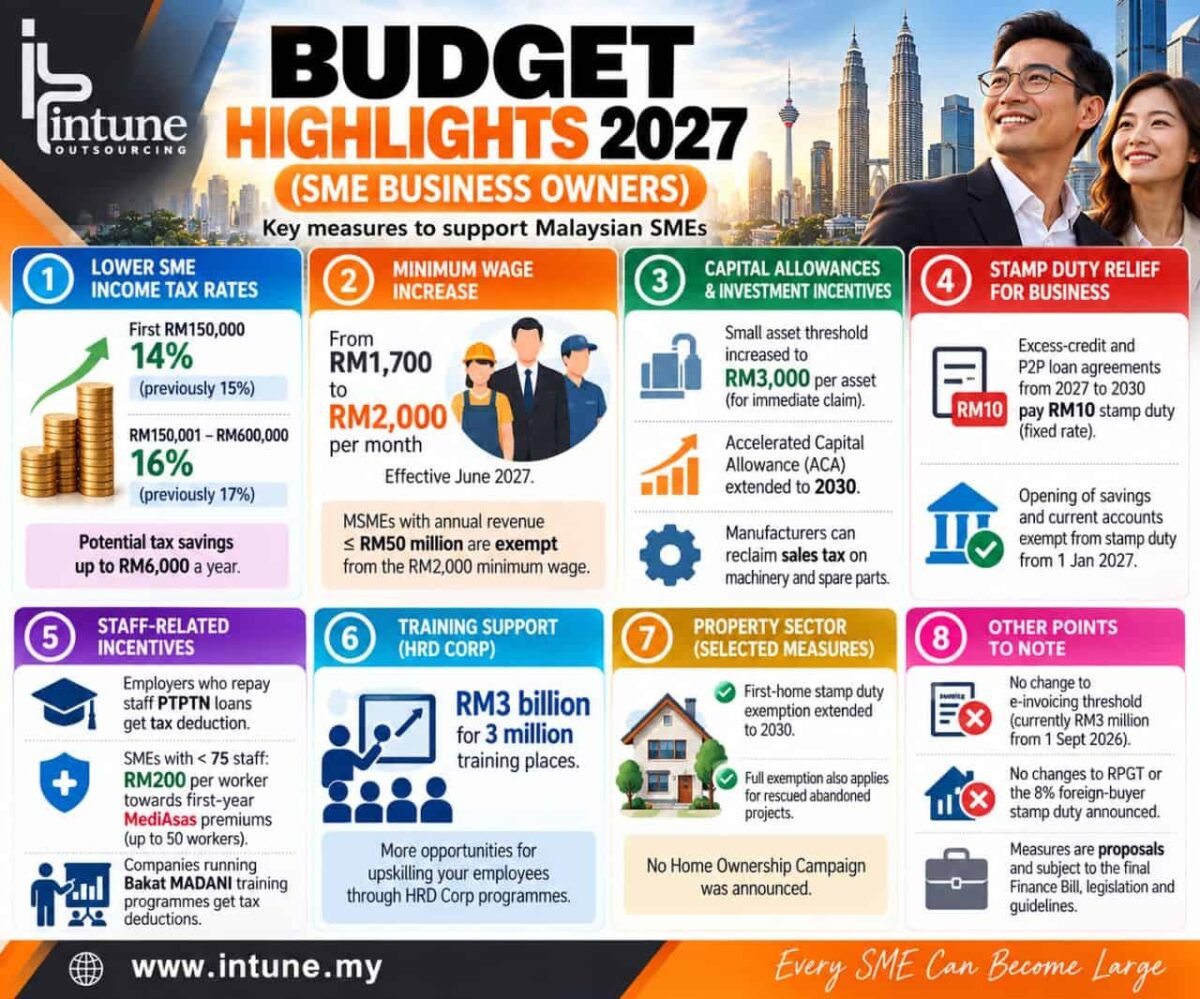
Budget Highlights 2027: What SME Business Owners in Malaysia Need to Know
Malaysia’s Budget 2027, presented on 9 October 2026, announced several proposed measures that could affect small and medium-sized enterprises (SMEs), from corporate income tax and employee wages to business investment, training and financing. For SME business owners, understanding these changes is important. While tax reductions and incentives may improve cash flow, changes to employment costs and compliance obligations also need careful planning.
1. Lower SME Corporate Income Tax Rates
One of the key announcements is a proposed reduction in SME corporate income tax rates.
- First RM150,000 of chargeable income: reduced from 15% to 14%.
- Next RM450,000 of chargeable income: reduced from 17% to 16%.
These proposed rates apply to qualifying SMEs, subject to the applicable eligibility conditions.
Example: For a qualifying SME with RM600,000 in chargeable income:
| Taxable income band | Previous rate | Proposed rate |
| First RM150,000 | 15% | 14% |
| Next RM450,000 | 17% | 16% |
| Total tax payable | RM99,000 | RM93,000 |
The potential tax saving is RM6,000 per year, assuming the entire RM600,000 qualifies for these rates and no other adjustments apply.
Business owners should not assume that every company qualifies. Existing SME tax conditions include requirements relating to paid-up capital, gross business income and shareholding. Confirm the final qualifying conditions before applying the revised rates.
2. Minimum Wage Increase to RM2,000
The Budget announced a proposed increase in the minimum wage from RM1,700 to RM2,000 per month, effective June 2027. A RM2,500 wage floor was also highlighted for semi-skilled workers and graduates.
The reported proposal provides an exemption from the RM2,000 rate for MSMEs with annual revenue of RM50 million or less. Employers should carefully check the final Minimum Wages Order to confirm the exact exemption, qualifying employer categories and applicable worker groups.
What should employers do?
- Review the current salary structure.
- Identify employees who may be affected by the revised wage requirements.
- Budget for higher salaries and related employer statutory contributions where applicable.
- Review salary bands to maintain fairness between employees with different levels of responsibility and experience.
A minimum-wage exemption does not automatically exempt an employer from other existing employment, contract or statutory obligations.
3. Capital Allowances and Investment Incentives
The Budget proposes increasing the small-asset threshold to RM3,000 per asset and extending the Accelerated Capital Allowance (ACA) until 2030. Manufacturers may also benefit from proposed sales tax recovery measures for machinery and spare parts, subject to the applicable rules.
These measures could support businesses investing in equipment, technology and productivity improvements.
Example: An SME purchasing computers, office equipment or other qualifying business assets should review the revised threshold and determine whether the expenditure qualifies for an immediate claim or must be treated under the applicable capital allowance rules.
Do not automatically treat every asset costing RM3,000 or less as fully deductible. The final rules, asset classification and qualifying conditions must be checked.
4. Stamp Duty Relief for Business Financing
The Budget proposes a fixed RM10 stamp duty for qualifying excess-credit and peer-to-peer (P2P) financing agreements during the announced 2027–2030 period. Stamp duty exemptions for opening savings and current accounts are also proposed from 1 January 2027.
For SMEs seeking financing, these measures could reduce certain transaction costs. However, business owners should distinguish between stamp duty payable on financing documentation and the overall cost of borrowing. Interest, financing fees, repayment terms and other charges still need to be considered.
5. Staff Benefits and Employer Incentives
PTPTN loan repayments
Employers who repay their employees’ PTPTN loans may qualify for a tax deduction, subject to the final qualifying conditions. This could provide an additional employee benefit while helping staff manage their financial commitments.
MediAsas medical insurance support
Eligible SMEs with fewer than 75 employees may receive RM200 per worker towards first-year MediAsas premiums, for up to 50 workers. Employers should confirm the application procedure, eligible employee categories, qualifying insurance arrangements and payment conditions before including this assistance in their budgets.
Bakat MADANI training
Companies conducting qualifying Bakat MADANI training programmes may benefit from tax deductions under the announced measures. Employers should retain training records, invoices, attendance lists and supporting documents to substantiate any eventual claim.
6. HRD Corp Training Support
The Budget announced RM3 billion for three million training places through HRD Corp. This could create further opportunities for employers to develop their workforce, improve productivity and strengthen management capabilities.
SMEs should identify training needs in areas such as:
- Digitalisation and artificial intelligence.
- Accounting and financial management.
- Human resource management and payroll compliance.
- Sales, marketing and customer service.
- Leadership, communication and supervisory skills.
Employers should check the relevant HRD Corp eligibility, levy and claim requirements before committing to a training programme. An announced allocation does not automatically mean every course or employee will qualify for funding.
7. Property Sector Measures
The Budget proposes extending the first-time homebuyer stamp duty exemption arrangements until 2030, subject to qualifying conditions. Full exemption was also announced for qualifying rescued abandoned housing projects.
These measures may support eligible homebuyers and developers involved in qualifying projects. Property developers and real estate businesses should review the final rules before incorporating these benefits into marketing materials, sales quotations or purchase cost estimates.
8. E-Invoicing and Other Tax Matters
Based on the Budget coverage available at the time of writing, no new change to the e-Invoice exemption threshold was identified. The reported threshold for businesses with annual revenue of RM3 million or less took effect from 1 September 2026, subject to the applicable LHDN guidelines and conditions.
Businesses should continue to monitor official LHDN updates rather than assuming that all e-Invoice obligations have been removed. Likewise, the absence of a newly announced measure does not mean existing tax obligations have changed or been abolished.
What Should SME Business Owners Do Now?
- Review your tax position. Check your company’s eligibility for the proposed SME tax rates and estimate the potential savings.
- Update your cash flow forecast. Consider salary adjustments, statutory contributions, financing costs and planned capital expenditure.
- Review your HR and payroll structure. Identify employees who may be affected by the proposed minimum-wage changes and verify the final requirements.
- Assess available incentives. Review qualifying training, employee benefits, investment allowances and financing-related stamp duty measures.
- Strengthen your accounting records. Maintain accurate financial statements, payroll records, invoices, asset registers and supporting documents to substantiate tax claims and demonstrate compliance.
- Verify before acting. Wait for the relevant legislation, orders and official guidelines where the measures have not yet been finalised.
Conclusion
Budget 2027 presents several potential opportunities for Malaysian SMEs to reduce selected tax costs, improve employee benefits and invest in workforce development.
However, the real benefit depends on eligibility, implementation dates and the ability of each business to manage its cash flow effectively. A tax saving of RM6,000 is useful, but avoiding payroll errors, managing working capital and maintaining proper financial records can be equally important to a company’s long-term sustainability.
The best approach is to plan early, verify the rules and make business decisions based on your actual financial position.
Important Disclaimer
This article is prepared for general educational and informational purposes only, based on reported Budget 2027 announcements available as at 9 October 2026.
The measures described may remain proposals until the relevant Finance Bill, legislation, subsidiary legislation, ministerial orders or official guidelines are finalised and take effect. Rates, eligibility criteria, exemptions, effective dates and claim conditions may change.
Readers should independently verify the latest requirements with the Inland Revenue Board of Malaysia (LHDN), Ministry of Finance (MOF), Ministry of Human Resources, HRD Corp and other relevant authorities before making tax claims, payroll decisions, financing commitments or other business decisions.
This article does not constitute tax, legal, accounting or financial advice. Businesses should obtain professional advice based on their specific circumstances.
How InTune Outsourcing Can Support SME Business Owners
Managing a business involves more than generating sales. Business owners must also manage accounting, cash flow, payroll, human resources and statutory compliance.
InTune Outsourcing provides accounting, finance, payroll and HR outsourcing services to Malaysian SMEs. We help business owners maintain accurate financial records, manage payroll and statutory obligations, prepare financial reports and improve their visibility over business performance.
With proper financial information and reliable administrative support, business owners can make better-informed decisions and focus on growing their businesses.
Need support with your accounting, payroll, HR or financial management? Contact us now.